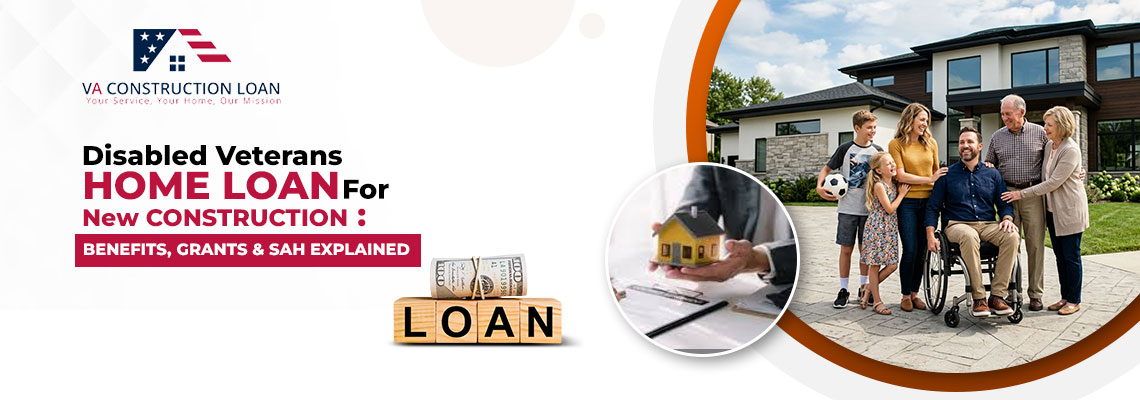
Finding a house as a disabled Veteran, that actually meets your needs is like taking on another full-time job. You visit “accessible” homes to discover that the doorways are too narrow, the driveway is too steep, and the countertops are out of reach.
What’s worse is that the price of updating an older home could take all your savings before you even have a chance to live there. You fought for your country; you shouldn’t have to fight for your house.
What would it be like to wake up in a home where your doorways, light switches, and showers cater perfectly to you? The ability to own a new build through a home loan for disabled veterans makes this possible. Pair the VA Construction loan with the accessible housing grants.
Build your personalized barrier-free home with no out-of-pocket cost. We are here to give the required Mortgage assistance to disabled veterans through out their home building process. Continue to learn more about how you can avoid the “fixer-upper” trap and build your new home to your specifications.
What Is a VA Construction Loan for Disabled Veterans? (And How It Works in 2026)
Eligible veterans with service–connected disabilities can be approved for a VA construction loan by the U.S. Department of Veterans Affairs. This type of loan allows a disabled veteran to construct a new home with zero down payment by covering the cost of land, building costs, and the long–term loan/ mortgage.
The VA construction loan for disabled veterans offers a number of advantages, including:
- Competitive interest rates compared to traditional forms of financing
- The borrower does not have to pay PMI (Private Mortgage Insurance)
- Reduced out-of-pocket money at the closing of the loan
Additionally, if the disabled veteran has had a service–related disability, the VA may approve a waiver of the VA funding fee, which makes the overall costs of the VA construction loan even more affordable for the disabled veteran. Disabled veterans who are approved for a VA construction loan will be able to create a custom–built home with specific accessibility features that meet the needs of the disabled veteran. In addition, although the VA no longer requires builders to possess an ID from the VA, the builder must still comply with the lender’s qualification process to be able to utilize the financing option.
7 Key Benefits of a VA Home Loan for 100% Disabled Veterans Building New
The usual VA benefits are fantastic and make this one of the top loan options on its own. But for a disabled vet specifically, the financial benefit of this alone surpasses any standard loan.
-
100% Financing– You can build on land that you currently own, or finance the land as well as the construction.
-
No Monthly Insurance– You save hundreds of dollars monthly since there is no private mortgage insurance (PMI).
-
Low Rates – VA construction loan rates are consistently lower than conventional construction loan rates.
-
Builder Scrutiny – The VA closely monitors the builder to ensure it meets its “Minimum Property Requirements.“
Special VA Construction Loan Advantages for Disabled Veterans
The financing waivers and design choices are just a few of the benefits. Utilize federal “gift” funds to reduce the total loan amount even before construction commences.
-
VA Funding Fee Waiver for Disabled Veterans
The largest monetary advantage given to disabled heroes is the exemption from the funding fee. It is most often 2.15% to 3.3%; however, it is removed entirely when a veteran has a disability rating of 10% or higher.
-
Higher Accessibility Customization Options
Since you are building new, you can incorporate medical technology into the very “bones” of your house. Ceiling tracks and reinforced walls allow for the installation of grab bars during construction. Home automation sensors of many types can be added while your house is being framed.
-
Increased Financial Flexibility During Construction
The VA SAH grant may serve as your down payment, effectively lowering your loan amount. Therefore, your monthly payments can be minimized even before construction begins.
Property Tax Exemptions for Disabled Veterans
Many states offer property tax exemptions or reductions for disabled veterans, helping lower the overall cost of homeownership. A 100% disabled veteran property tax exemption may be available to veterans with a qualifying service-connected disability rating, potentially eliminating property taxes on their primary residence. Eligibility requirements and exemption amounts vary by state, and some states also extend benefits to surviving spouses. These tax savings can significantly reduce annual housing expenses, making homeownership more affordable for veterans and their families. Veterans should review their state’s guidelines to determine their eligibility and available benefits.
–> Check states-specific guidelines for 100% disabled veteran property tax exemption
SAH vs SHA vs TRA: Which VA Adaptive Housing Grant Is Right for You?
For Veterans planning to build a new custom home, the VA offers three adaptive housing grants that can help cover accessibility-focused construction costs. SAH is designed for Veterans with severe mobility disabilities who need a fully adapted permanent home, while SHA supports specific accessibility features for qualifying disabilities. TRA provides temporary assistance when a Veteran is staying with family during the construction or transition period.
SAH (Specially Adapted Housing)
- Helps build a fully accessible custom home
- Best for severe mobility-related disabilities
- Covers major structural accessibility features
SHA (Special Housing Adaptation)
- Supports accessibility upgrades in a newly built home
- Designed for qualifying visual, burn, or hand-related disabilities
- Helps fund smaller adaptation features
TRA (Temporary Residence Adaptation)
- Used while temporarily living with family during construction
- Helps modify a family member’s home for accessibility
- Available to Veterans already eligible for SAH or SHA
How the SAH Grant Works with a VA Construction Loan: Up to $126,526 for New Builds
The SAH grant is a great resource, but it is applied for much differently than a traditional mortgage. You’ll want to understand how SAH funds will work with your mortgage so you can budget for your home.
The VA (Specially Adapted Housing) grant program is very useful. The grant is not money you’ll need to pay back, unlike a mortgage.
-
Combining Funds
This grant money may be used to fund your ” adaptive” portion of the new build. The home loan will fund the construction of your home, and the grant will cover your ramp, automatic door, and “specialty” bathroom fixtures.
-
Maximum Grant Limits
For 2026, the largest possible SAH grant is $126,526. The VA revises this figure annually to reflect rising construction costs.
-
SAH Grant Application
For the SAH application, the VA Form 26-4555 must be submitted to the VA, typically using the eBenefits system. Begin this application before completing the plans.
-
SAH Grant Requirements
To be eligible for an SAH grant, you must be 100 percent disabled on a permanent and total basis. Examples of service-connected total, permanent disability include loss of use of both lower limbs or loss of vision in both eyes.
Do You Qualify? Full Eligibility Checklist for Disabled Veterans VA Construction Loans
Qualifying for an adaptive housing grant is only part of the process. To build a custom home using a VA construction loan, 100% disabled Veterans must also meet VA lending requirements and financial eligibility guidelines.
To qualify for both the construction loan and adaptive housing benefits, 100% disabled Veterans typically must meet the following requirements:
Service Requirements
To qualify for a VA One-time close construction loan for disabled veterans, borrowers must meet the VA’s military service requirements and have a discharge status that is anything other than dishonorable. Eligibility is generally based on the length and type of military service completed during active duty, Reserve, or National Guard service. Veterans who meet these service standards can apply for VA-backed home financing benefits through an VA approved lender.
Disability Rating
A veteran’s disability rating can affect access to additional VA benefits connected to homeownership. Veterans with a service-connected disability rating of at least 10% are typically exempt from paying the VA funding fee, which can significantly reduce upfront loan costs. For Specially Adapted Housing (SAH) grants, veterans usually need a permanent and total (P&T) disability rating to qualify for financial assistance for accessibility-focused home modifications.
Certificate of Eligibility (COE)
The Certificate of Eligibility (COE) is an official VA document confirming that a veteran qualifies for VA home loan benefits. When applying for a VA construction loan, the COE should show available “entitlement,” which represents the amount the VA guarantees on the loan. Lenders use this document to verify eligibility before approving financing.
Credit & Income Requirements
Although VA loans are known for flexible qualification standards, lenders still evaluate a borrower’s financial stability before approval. Most lenders prefer a minimum credit score of around 620, though some may have different requirements depending on the loan program. Borrowers must also demonstrate stable and sufficient income to cover monthly mortgage payments, existing debts, and other financial obligations.
Builder Approval
The VA no longer requires builders to obtain a VA Builder ID for construction loans. However, lenders still maintain their own builder approval process to ensure the contractor is qualified and financially reliable. In most cases, VA-adapted housing builder must be properly licensed, insured, and registered according to state or local regulations, while also meeting the lender’s construction and documentation requirements.
How to Use a Disabled Veterans Home Loan to Build an Accessible Home?
Building an accessible custom home with a disabled Veterans home loan involves combining VA construction financing with approved adaptive housing benefits to create a home tailored to your mobility and accessibility needs.
Once your eligibility, financing, and adaptive housing approvals are in place, you can move forward with the construction process confidently while ensuring the home meets VA and federal accessibility standards.
The process of building to follow:
- Get Your COE: Submit your Certificate of Eligibility (COE) and supporting military service documents to confirm your qualification for VA home loan benefits.
- Pre-Approval: Complete the lender’s pre-approval process to determine how much you may qualify to borrow based on your income, credit, and financial profile.
- Choose a Builder: Select a licensed and experienced VA-adapted housing builder who can meet the lender’s construction requirements and approval guidelines for the project.
- Apply for the SAH/SHA Grant: If eligible, apply for the SAH or SHA grant so approved accessibility funds can be included in your overall construction budget.
- Construction & Inspections: During construction, the lender releases funds to the builder in stages while inspections are completed to verify progress and quality.
- Conversion: Once the home is finished and the Certificate of Occupancy is issued, the construction loan converts into a permanent 15- or 30-year VA mortgage.
ADA Accessibility Features You Can Build Into Your New Home (VA-Approved)
ADA accessibility features help disabled Veterans create a safer, more functional, and easier-to-navigate custom home using a VA construction loan and adaptive housing benefits.
Beyond meeting accessibility guidelines, the goal is to build a home that supports daily independence, comfort, and long-term mobility. Choosing the right ADA-approved features can make everyday living easier throughout your disabled Veterans VA construction loan journey.
-
Wheelchair Ramps: Construct year-round, warmed ramps that never become slippery.
-
Roll-in Showers: Design bathrooms with zero-threshold entries and seats integrated into the shower stalls.
-
Lowered Counter tops: Design a kitchen with knee space at the sink and stove.
-
Multi-level Accessibility: During construction, install domestic lifts or stair lifts.
VA Adaptive Housing Grant Application: How to Apply for SAH Using VA Form 26-4555
Applying for a Specially Adapted Housing (SAH) grant using VA Form 26-4555 is a streamlined process. The form itself takes only about 10 minutes to fill out, but following the correct procedural steps ensures you avoid lengthy administrative delays.
1. Gather Your Information:
Before opening the form, make sure you have your Social Security Number, your VA File/Claim Number, and current contact details on hand. You will also need to state whether you already own the land you intend to build on, or if you plan to purchase land using the grant funding.
2. Choose Your Submission Method:
-
Online (Fastest): Log into VA.gov using a verified identity account (Login.gov or ID.me) to complete and submit the form digitally.
-
By Mail: Download the physical form, fill it out in ink, and mail it to the Department of Veterans Affairs, Claims Intake Center, PO Box 4444, Janesville, WI 53547.
-
In Person: Take the filled-out form to your nearest VA regional office or submit it through an accredited Veterans Service Officer (VSO).
3. Complete the Identity & Benefit Fields:
Fill out your personal information, including your date of birth and email. You must disclose whether you have ever applied for a housing or home improvement grant before, and whether you are currently confined to a nursing home or medical facility.
4. Secure Conditional Approval:
Once the SAH agent verifies that your project is feasible, you will receive Conditional Approval. This official status authorizes you to move forward with pre-construction steps, allowing you to use portions of your funding to cover necessary pre-construction costs like hiring architects and structural engineers.
5. Submit Blueprints, Specifications, and Builder Bids:Plans & Bids.
To unlock Final Approval, you must submit your complete architectural blueprints and material specifications to the VA. These plans must strictly incorporate mandatory Minimum Property Requirements (MPRs) for accessibility, such as zero-step entries, wide hallways, and roll-in showers. Additionally, you must source formal construction bids from VA-licensed and bonded builders.
Critical New Construction Warning: Do not sign a binding contract with a custom home builder, purchase land specifically for this project, or break ground until you have transitioned from Conditional Approval to Final Approval in writing from your SAH agent. Breaking ground early disqualifies those specific construction phases from being covered by your grant money.
5 Common VA Construction Loan Challenges for 100 % Disabled Veterans (and How to Avoid Them)
Building an accessible custom home with a VA construction loan can be rewarding, but many 100% disabled Veterans face unique challenges during financing, planning, approvals, and construction. Understanding these issues early can help prevent delays, unexpected costs, and project complications.
Common VA construction loan challenges include:
1. Finding a VA-approved builder and understanding current VA requirements:
Many Veterans still struggle to find a “VA-approved builder” because of outdated information online. While the VA no longer requires a VA Builder ID in many cases, lenders may still have their own builder approval standards. To avoid delays, work with a lender that already has experienced VA construction builders in their network.
2. Incorporating ADA or disability adaptations into the home design:
Accessibility features such as wheelchair-friendly layouts, roll-in showers, wider doorways, ramps, and elevators require detailed planning before construction begins. To avoid expensive redesigns later, include all ADA and adaptive housing requirements during the architectural planning stage.
3. Finding lenders experienced with VA One-Time Close construction loans:
Many lenders only handle traditional VA home purchase loans and may not understand construction draws, inspections, or adaptive housing grants. To avoid financing issues, choose a VA Construction loan lender that regularly works with disabled Veterans and VA construction projects.
4. Managing VA inspections, appraisals, and construction timelines:
VA construction loans involve multiple inspections, approvals, and VA appraisal reviews throughout the building process. Delays with permits, contractors, or documentation can slow the project. Staying organized and working with an experienced VA-adapted housing builder can help keep construction on schedule.
5. Staying within budget while handling specialized upgrades and change orders:
Accessibility upgrades and mid-project design changes can quickly increase costs during construction. To avoid budget overruns, create a detailed construction plan early and leave room for contingency expenses before breaking ground.
Choosing the Right VA Construction Loan Lender for Disabled Veterans
Building a custom home can feel overwhelming, especially when you also need to meet VA loan requirements, accessibility guidelines, and construction approvals. But disabled Veterans do not have to handle the process alone. An experienced VA construction loan specialist can give mortgage assistance for disabled veterans along with can coordinate for your SAH grant, financing, builder requirements, and accessibility features to make the process much smoother.
Shirley Mueller at VA Construction Loan is among the industry’s top people. Shirley knows the 2026 VA criteria and works with Disabled veterans through the tangled world of builder approval and grant execution.
Working with a specialist will ensure your home complies with VA requirements and that your funds remain safe. Get the desired mortgage assistance from the Experts.