Many Veterans buy land assuming they can use a VA construction loan when they’re ready to build. Unfortunately, that decision can create financing problems later. Some lots do not meet lender requirements.
Others lack utilities, legal access, or builder approval. Before you sign a land contract, it’s important to understand when a VA construction loan can include land and when it cannot.
In some situations, a VA construction loan can finance both the land purchase and the home build. In others, Veterans may need separate land financing before construction begins. Understanding these differences before purchasing property can help avoid delays, unexpected costs, and financing issues later.
The Direct Answer: Can You Use a VA Construction Loan to Buy Land and Build Later?
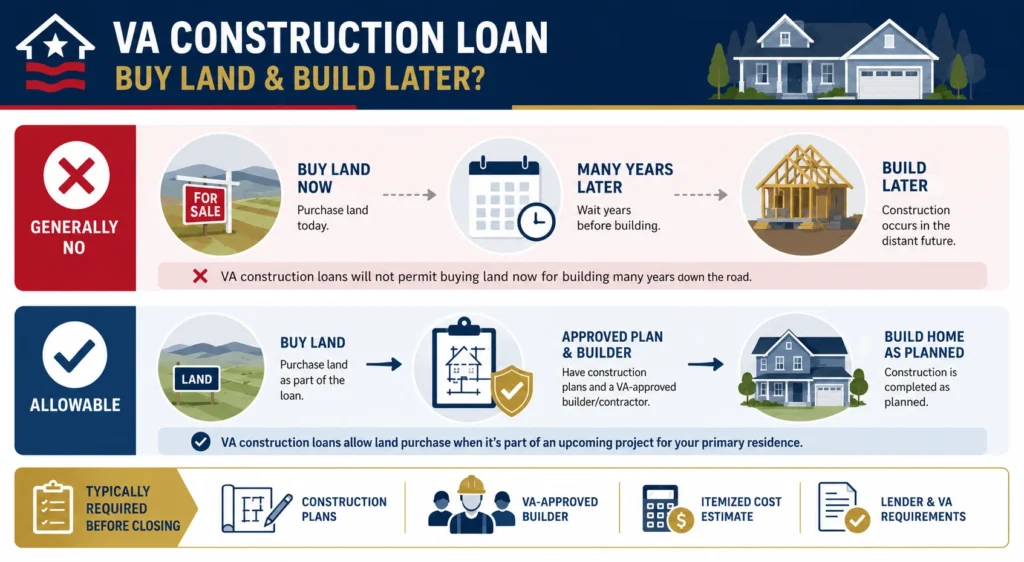
Usually no. Generally, a VA construction loan will not permit the purchase of land now for building that will occur many years down the road. Most lenders demand that the land purchase be associated with an upcoming project for a primary residence.
Construction plans and a contract with a builder that meets lender and VA construction requirements are typically needed before closing. Usually, an itemized construction cost estimate is also needed at this time for loan purposes.
The difference exists because standard VA loans and VA construction loans serve different purposes. Buying land alone with a conventional VA loan is typically not an option. Often, a VA construction loan will allow you to buy the land if you also have a home plan approved. Construction will then be carried out exactly in accordance with the loan guidelines.
When a VA Loan Can Include Land?
A VA construction loan that includes both land and construction costs may be appropriate in the following situations:
- If you’re buying the land and home together with a VA One-Time Close Construction Loan.
- If you already own the land and would like to build on it.
- If you’ve recently purchased the land, and the lender permits it to be included in the total construction costs.
- If you wish to use your existing land equity as the portion toward a VA construction loan.
In these circumstances, a VA land and construction loan can finance both the land and the future home as part of a single approved transaction.
Why Veterans Should Confirm Land and Project Eligibility Before Buying Property?
One of the most common mistakes Veterans make is purchasing land before confirming financing eligibility—most of the time, they buy land that is not financeable under tight VA construction financing rules.
Many properties appear suitable at first glance but fail to meet lender requirements after a detailed review. Common issues include zoning restrictions, limited utility access, poor soil conditions, and legal access concerns.
Ensuring the land is financeable first may help avoid costly delays.
Why VA Loans Generally Do Not Allow Land-Only Purchases?
Most Veterans believe that once there is a plan to build on a property, it qualifies for VA loan funding. VA loan rules are designed for owner-occupied properties, not for vacant land intended for future building.
The intended use for VA borrowers is owner occupancy of the structure once it is built. Vacant land can’t be used for housing and doesn’t qualify for owner occupancy. Unimproved property usually does not qualify as the target of a construction project.
Can Raw Land Qualify For A VA Construction Loan?
It’s important to note that not all vacant land is eligible for VA construction financing. Since raw land is subject to more scrutiny, it’s usually because it lacks septic, road, or utility access, zoning approval, or room for residential use.
Underwriters verify that the land is suitable to support an owner-occupied primary residence that meets VA Minimum Property Requirements.
Can I Buy Land And Use a VA Construction Loan Later?
Yes, if certain criteria are met.
If you purchase land today with your own financing, you may later use a VA construction loan to build a house on the land you own. Lenders will evaluate the property to ensure it’s buildable, has utilities, is properly zoned, and that the current market value of the land, plus the proposed construction plans, will be adequate.
Veterans need to verify these criteria before buying land, as not all land will qualify for VA construction loans later.
Two Common Ways Veterans Finance Land and Construction?
Generally, you cannot buy land now and build later using conventional VA financing. There is, however, a limited-circumstance special VA construction loan to buy the land in some cases.
- When Building on Previously Owned Land Using VA Home Construction Financing: It is common for Veterans to purchase land before beginning construction. Once construction commences, a lender may allow the land’s value to count toward the project cost. This often fits a borrower looking for VA construction loans on owned land well.
- When Using a VA Loan for Land and Construction to Satisfy an Existing Lot Balance: Other people finance the land lot separately and don’t intend to build on it until later. You could use the combined VA land and construction loan to pay off the lot balance and add it to the construction cost. However, whether or not this is allowed will be lender-specific.
How Existing Land Ownership May Affect a VA Construction Loan?
If you already own the land, existing equity can be used to help the project. Lenders may be willing to apply existing land equity towards the entire transaction. To utilize land equity toward a VA construction loan, veterans need to review their land ownership history with their lender. The discussion also needs to address how land valuation will affect the process.
Can You Use A VA Construction Loan On Land You Already Own?
We receive calls from many Veterans who purchased their land months or even years before construction began.
Existing land ownership can strengthen the project, as the land itself may hold sufficient equity. Lenders typically evaluate:
- Current value
- Liens
- Existing land loan balance
- How long has it been owned
- Applicability of the property to the construction project
How land equity is handled varies by lender; therefore, reviewing the land before finalizing the construction design is recommended.
Before You Buy Land: 7 Questions Every Veteran Should Ask
Not every lot is ideal for construction. You can investigate a property before purchasing to identify issues that may affect approval, cost, and timing.
1. Is The Property Buildable?
Check local zoning requirements and restrictions regarding residential use.
2. Are Utilities Available?
Confirm if you have access to electrical service, water, sewer service, and internet service.
3. Is There Legal Road Access?
Permanent legal access often affects the lender’s decision to extend a construction loan.
4. Will the Property Need Its Own Well or Septic System?
Rural properties can require significant further development before construction can start.
5. Are There Flood Concerns?
Required flood insurance can increase the total cost of ownership and affect loan affordability.
6. Are There Deed Restrictions?
There may be limitations on the home that you can build.
7. Will The Builder And Lender Approve The Property?
Not all lots are acceptable for VA construction loans.
Before you commit to purchasing a lot, find out:
- Legal access
- Utility availability
- Zoning requirements
- Flood zone issues
- Survey availability
- The selected builder is willing and able to construct the home on the property.
- The lender is willing to finance construction on the property.
- Whether it is buildable
Common Issues We See During VA Construction Loan Reviews
Many of these are identified during underwriting and occur only after the Veteran has entered into a purchase agreement for the land.
Problems identified during underwriting:
- No public utilities are accessible to the property.
- Septic or well approval difficulties.
- Flood zoning and added insurance costs.
- Zoning prohibits the building of residential homes on the property.
- Access to property or easement issues.
- The selected builder does not meet lender construction requirements or lacks the experience needed for the project.
- Appraisal issues vs. Purchase price.
What Lenders Review Before Approving a VA Construction Loan?
A lender must review various components before authorizing a VA construction loan. Among them are verifying the feasibility of constructing the property, ensuring utilities are in place, and confirming that zoning allows residential construction.
Local zoning laws, builder experience, construction budget, value of the finished home once built, and borrower use are all included in the lender’s review.
Veterans who want a deeper understanding of lender requirements can review our guide.
VA Construction Loan Requirements for Land
The land is the next most important item for loan approval. Lenders do not look at a property’s purchase price alone when evaluating it.
Usual VA construction loan requirements are;
- Legal access
- Usable and zoned for residential
- Utilities in place or able to reach the site
- Well and septic capable
- Boundaries of the property
- Environmental issues (toxic waste, endangered species, etc.)
- The property has to support construction, and no material can be delivered, and no labor can commence until the loan has closed.
The property must be suitable for a residence and comply with the VA Minimum Property Requirements. This means the property must meet certain standards for sanitation, safety, and occupancy year-round.
VA Construction Loan Eligibility: COE, Income, Credit, Residual Income, and Occupancy Intent
The loan must also be for a construction that the VA will approve. Lenders will generally check the borrower’s:
- COE
- Income stability
- Job history
- Credit score
- Residual income
- Outstanding debts
- Intended usage of the home
The borrower must plan to live in the completed home as their principal residence.
Before purchasing land, it helps to review the full VA construction loan eligibility requirements to determine whether you qualify.
VA Construction Loan Builder Requirements: Licensing, Experience, Insurance, and Lender Review
The role your builder plays is crucial to project approval and successful project completion.
Generally, most lenders will check:
- State licensing
- Insurance
- Construction experience
- Financial stability
- References
- History of the project
So, while securing the land is definitely a key factor, builder approval is equally critical for a VA construction loan. If you and the lot pass the lender’s checks but the builder doesn’t, the project won’t move forward.
Unlike a standard home purchase, lenders must vet the builder’s qualifications, experience, and stability before construction starts. They typically review:
- Active licensing and insurance (liability and workers’ comp)
- Experience, project background, and references in the industry
- Financial stability and ability to complete work
This affects your time frame. Lenders typically need this to order the appraisal. If you don’t have the builder’s paperwork, your underwriting, NOV, and closing will all be delayed.
Communicate builder requests and responsibilities early to prevent delays after the land contract is signed. Selecting a seasoned, documented builder familiar with lender draw schedules results in a much smoother process.
Comparison: VA Construction Loan to Buy Land vs. Land Loan for Veterans vs. Build-Then-VA Refinance
| Financing Option | Best For | Advantages | Limitations |
|---|---|---|---|
| VA Construction Loan | Buying land and building now | One closing, one loan, permanent financing built in | Requires an approved construction project |
| Conventional Land Financing | Buying land for future use | Greater flexibility for future building plans | Higher interest rates and larger down payment requirements |
| Build-Then-VA Refinance | Using separate construction financing first | More lender options during construction | Requires refinancing after the home is completed |
The best option depends on your construction timeline and financing goals.
VA Construction Loan Process When the Land Purchase Is Included
If you want a detailed breakdown of each stage, review our complete VA construction loan process timeline from closing to homeownership. Understanding the process helps Veterans plan more effectively and avoid delays.
1. Get Prequalified Before Offering on the Lot
Pre-qualification allows you to know what you can afford and how much you qualify for.
2. Verify the Lot is Compatible with a VA-Eligible Principal Residence
The loan provider considers the utilities, land accessibility, zoning, and site characteristics.
3. Select a Builder, Develop the Plans, Specs, Budget, and Sign the Agreement
The lender needs all construction plans before beginning loan underwriting.
4. Complete the Appraisal, Underwriting, Closing, and the Draw Schedule Authorization
Before granting final approval, the lender verifies the borrower, builder, lot, and project cost.
5. Construction Draws, Inspections, Borrower Authorization, Certificate of Occupancy
Funds are released as each stage of construction is completed and inspected.
6. Convert to a Permanent Loan once the home is Complete
Most borrowers utilize a VA One-Time Close Construction Loan. With a VA OTC structure, permanent financing is secured before construction begins.
The loan will transition from the construction to permanent financing once the home is constructed, all final inspections are completed, and occupancy is taken. During the lender’s alteration procedure, the mortgage will shift from construction to the standard loan phase.
You can also download our complete VA construction loan process guide to help track each stage of the project.
Common Mistakes Veterans Make When Trying to Buy Land with a VA Loan
- Pre-Approved: You Intend To Build At Some Point (No): The intent alone does not qualify the raw land for use in a VA construction loan.
- Beginning Site Work Or Construction Before Your VA Construction Loan Has Closed (No): Beginning work prematurely can cause many financial issues.
- Purchasing Raw Land Without Verifying Access, Utilities, Septic, Zoning, And Building Permits (No): Property issues are discovered after the land is purchased, not before.
- Selecting A Builder Before Checking The VA Construction Loan Builder Requirements (No): Not all builders meet lender construction requirements.
- Believing Your Loan Amount Will Increase Automatically After Change Orders (No): Increases often need review and re-approval by the lender.
- Waiting Too Long To Consult A VA Construction Loan Professional (No): Seeking advice early can potentially save the borrower money by avoiding the cost of fixing costly mistakes.
How to Choose a Lender That Offers VA Construction Financing?
You also need to find a lender, as not all offer VA construction loans, and very few do them particularly well. Ideally, look for a lender who has:
- Significant experience doing VA construction loans.
- The ability to have a builder approved.
- Clear processes around administering draws.
- Good communication skills
- Experience in doing construction-to-permanent loans.
- A good lender will make this a smooth process and avoid delays.
When Should Veterans Speak With A VA Construction Loan Specialist?
The perfect time to get advice on your land purchase is before you enter into a purchase contract.
An expert in VA construction can assist you with reviewing:
- Land eligibility
- Availability of utilities
- Qualifications of the builder
- Project time frame
- Financing available
Solving problems such as these early will save money down the road.
Expert Insight
A common issue we encounter is that Veterans purchase land before verifying that the builder is approved to work in the jurisdiction, that utilities are available, that zoning issues are addressed, and that lender approval is obtained.
Some land looks good on paper, but doesn’t pass the requirements for construction financing. Meeting with the VA construction lender to review the land before purchase saves us from expensive headaches.
Questions To Ask Before Buying Land with A VA Construction Loan
Sample questions:
- Will this land qualify for a VA construction loan?
- Can equity in the land be used for the project?
- Are there builder approval requirements?
- Do utilities have to be on the property before closing?
- What appraisal standards are used?
- Can the land loan be rolled into a construction loan?
VA Construction Loans — Helping Veterans Build With Confidence, From Land Selection to Move-In Day.
Buying the land first and not understanding the need for a construction loan can also lead to some difficult problems that could have been easily avoided. Veterans need to first assess the land, builder, loan, and construction process before buying the land. With appropriate planning, the land will remain available for building.
Before purchasing the land, you should check whether the land, builder, and loan all meet VA criteria. This may save you from future surprises.
Make sure the lot, the builder, and the loan you’re using fit with today’s VA construction loan guidelines before you buy the land.
Having this foresight before you buy can prevent future holdups between buying the land and moving into your new home. If you’re still in the early stages, experienced VA loan expert like Shirley Mueller can guide you through it all before you buy land.
Make sure you have a plan in place before signing a land contract if you would like to purchase land with a VA construction loan.
Frequently Asked Questions
1. Can I Use A VA Construction Loan To Buy Land Only?
No. A VA construction loan can generally not purchase a land-only deal. Land must have an approved construction loan in place to build a primary residence. Lenders usually require a plan, a competent builder, and a completion schedule before lending on a property.
2. Can I Buy Land With A VA Loan If I Plan To Build In A Few Years?
Not often. Usually, a VA construction loan is tied to a specific construction project rather than to the option to build at a future date. Veterans planning to buy land now and build in the future may use one of the above methods until they are ready to build their construction loan.
3. Can A VA One-Time Close Construction Loan Include The Land Purchase?
Yes. Once the builder meets lender requirements and the project satisfies VA and lender guidelines, a VA One-Time Close Construction Loan may cover both the land purchase and construction costs. The inspections and permanent financing are also included in one closing.
4. What If I Already Own Land And Want To Build With A VA Loan?
Most lenders will permit the existing value of the land to be incorporated in the project. Before disbursing any funds, the lender will have to examine the chain of title and current property values. They will also thoroughly review construction documents and any outstanding debts.
5. What Is The Best Land Loan For Veterans Who Want To Build Later?
Typically, veterans purchasing land for future construction will opt for alternatives to a VA construction loan. Often, a buyer will use local vacant land financing or general land loans through a traditional lender, or on occasion, seller financing or even a cash purchase. For these individuals, land loans are typically less restrictive and do not require immediate construction, unlike VA construction loans.
6. Can I Use A Non-VA Construction Loan And Refinance Into A VA Loan After The Home Is Built?
Yes. Some will take out a standard construction loan, build the house, and then refinance into the permanent VA mortgage. The method may be applicable in cases where a VA construction loan is not available for the purchase.
7. Can I Use Land Equity For A VA Construction Loan?
Perhaps. Some lenders may accept the value of the existing land into the total development project. A loan appraisal of the land will be completed. This will give an appraisal of the land’s value and history. The lender will also need to consider the debt encumbrance on the land, which it will factor into its evaluation.
8. How Long Does A VA Construction Loan Take From Start To Finish?
Borrowers are often looking at anything from weeks to months to prequalify and be approved by a builder/underwriter. The construction itself can take 6-12 months, depending on its size, location, permitting ease, and weather.
9. Can I Clear Land or Start Site Work Before My VA Construction Loan Closes?
Generally, no. Most lenders require the VA construction loan to close before any land clearing, grading, excavation, or other site work begins. Starting work before closing may create problems with the loan. Always check with your lender before beginning any work on the property.
10. Can I Install a Well or Septic System Before the Loan Closes?
Generally, no. Well and septic installation is usually completed after the loan has closed as part of the approved construction project. Installing these systems before closing may affect loan approval. Your lender should review any planned work before it begins.
11. Can I Deliver Building Materials to the Property Before Closing?
Generally, no. Building materials are typically delivered after the VA construction loan has closed and construction is ready to begin. Most lenders require all materials and labor to be part of the approved construction process after closing.