
So, your VA construction loan has closed. Now what?
Many veterans assume construction starts immediately after closing. In reality, several important steps must happen before the first shovel hits the ground. The post-closing process involves multiple moving parts.
You have drawings, schedules, inspections, builder communications, and change orders to worry about. Most importantly, you have strict guidelines to convert the construction loan into your permanent loan.
Most of what is written focuses on approval, with little to offer about what follows your closing once the walls of your house are raised.
This guide details the Entire VA Construction Loan Process & Timeline from Closing Day to Move-in Day. Planning is the key to any VA construction loan. We’re going to cover the details of what happens during each stage of the build. Following that, we will provide an estimation for how long it will take and ways you can actively manage the construction timeline.
You will understand the whole process, from the initial draw of funds to the first payment on your VA mortgage.
What Happens After a VA Construction Loan Closes?
Closing the loan is only the first step in the process. Once the loan closes, the project goes into construction. This involves managing the construction draws, inspections, and the builder. It will also involve any change order requests.
Once the home is complete and fully approved for occupancy, the loan will be converted to a permanent mortgage known as VA Construction to permanent loan. Most projects require 6-12 months from closing to moving in. This varies depending on how construction progresses, the pace of local permits and inspections.
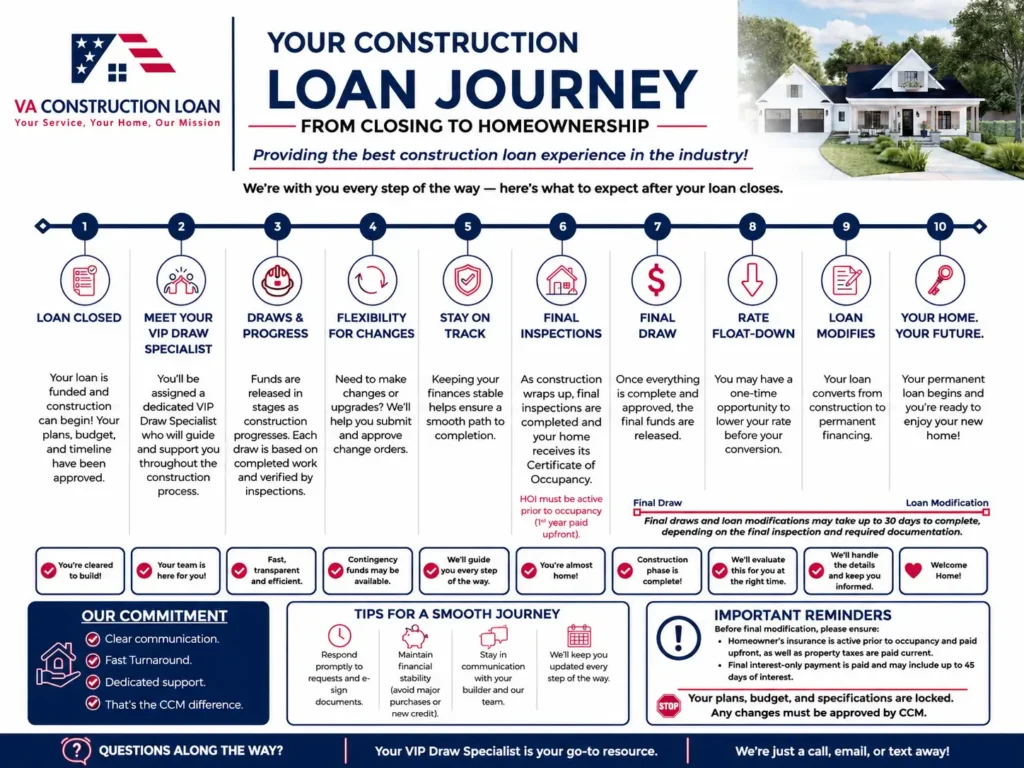
The VA Construction Loan Process Timeline: Step-by-step
Every loan is different, though, and most VA construction loans will follow these general steps after closing:
| Construction Stage | Typical Timeline |
| Loan Closing | Day 1 |
| Draw Specialist Introduction | Days 1–7 |
| Site Preparation & Foundation | Weeks 1–4 |
| Framing & Structural Work | Months 2–4 |
| Mechanical Systems | Months 3–6 |
| Interior Finishes | Months 5–9 |
| Final Inspections | Months 6–11 |
| Certificate of Occupancy | Near Completion |
| Final Draw Release | Final Week |
| Loan Modification | Varies by different lender |
| Permanent Mortgage Begins | Immediately After Conversion |
Stage 1 — Loan Closes: Your VA Construction Loan Is Officially Active
Closing officially starts the construction phase of your project. Upon closing, construction funds become available and are released according to the approved draw schedule.
At the closing of the loan, the loan documents are finally approved, and construction funding is active. Once the builder obtains the permit and prepares the lot, the builder can begin construction.
Your loan package will already contain:
-
The approved building plans
-
The budget for the project
-
The draw schedule
-
The contract with the builder
-
Contingency money
-
Relevant VA loan funding fee construction charges
Most homeowners anticipate receiving the equipment at the property the day after they close. The fact is, the builder is busy the first two weeks getting permits, lining up subcontractors, and readying the site.
Construction work generally should not begin before the construction loan closes. Starting work too early can create financing eligibility issues and may delay the loan process.
Stage 2 — Construction Administration Begins
After closing, construction begins once permits are issued and the builder is ready to start. Throughout construction, the lender’s construction administration team coordinates inspections, draw approvals, title updates, and fund disbursements. Builders typically request funds as construction milestones are completed, and borrower authorization is often required before funds are released.
Stage 3 — The VA Construction Loan Draw Schedule: How and When Funds Are Released?
Many people mistakenly think the builder receives the entire loan in a lump sum.
This is never the case.
Instead, construction money is released in phases based on progress. An inspection precedes each draw.
Example Draw Schedule
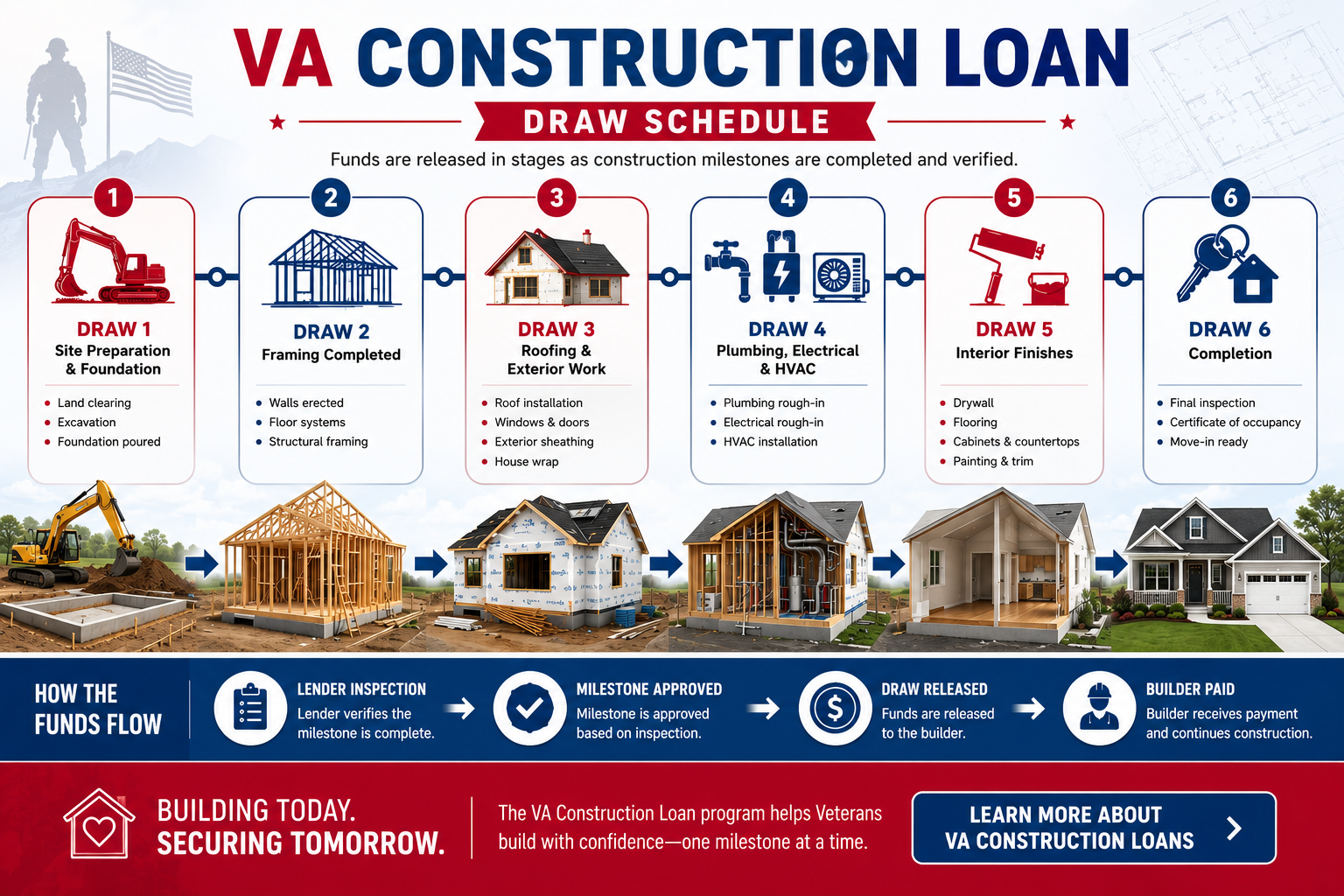
While draw schedules vary by lender and project, construction funds are generally released in phases as work is completed and verified through inspections.
What Most Veterans Don’t Know?
It is the expectation of many first-time home builders that the entire loan amount goes to the builder at the outset of the loan. That is not how VA construction loans work. This protects both the borrower and the lender by only allowing progress payments on the house to be released after they have been inspected.
Stage 4 — Change Orders During VA Construction: What’s Allowed and What Needs Approval
Modifications can occur on any number of construction jobs. A change order is a formal request to alter the construction plans, specifications, materials, or scope of work after construction has begun.
Common construction changes may include:
- Upgrading countertops
- Changing flooring selections
- Adding a patio or outdoor living space
- Relocating interior walls
- Modifying fixtures or finishes
Change orders and project upgrades can impact construction timelines, inspections, and approval processes. Depending on the project and loan structure, additional costs may need to be paid from contingency reserves or directly by the borrower. Significant changes may also require updated documentation, revised project schedules, or additional inspections before work can proceed.
Before construction begins, the builder typically must be reviewed and accepted by the lender for the project. Many lenders require builders to meet specific qualification standards related to licensing, insurance, experience, and financial stability before construction can move forward.
Check the Builder Requirements before proceeding.
Stage 5 — Staying Financially Stable During the Construction Phase
Your responsibilities do not end at closing. Maintaining strong financial health throughout the construction process remains important.
Construction financing structures vary by lender and program. Veterans should review how construction interest, contingency reserves, builder fees, and other project-related costs are handled before closing.
To help keep your project on track, avoid:
- Taking out new vehicle loans
- Accumulating large credit card balances
- Missing loan or credit payments
- Making major employment changes
- Taking on significant new debt
For example, purchasing a new vehicle during construction could increase your overall debt obligations and affect your financial profile. Significant financial changes during the construction period may create challenges if additional reviews or documentation are required before the home is completed.
Whenever possible, consider postponing major financial commitments until after you have moved into your new home.
Stage 6 — Final Inspections and the Certificate of Occupancy
Upon completion of the construction, final inspections commence.
Inspectors confirm:
-
Building conforms to approved plans.
-
Building code is complied with.
-
Safety codes are followed.
-
Mechanical systems are in working order.
-
Required permits are obtained.
Any identified defects must be corrected before proceeding.
What is a Certificate of Occupancy?
A Certificate of Occupancy (CO) is a document issued by the local government confirming that a building is habitable.
You cannot typically move into a house without a Certificate of Occupancy.
For most borrowers, the CO is the last big milestone before being a homeowner.
Stage 7 — The Final Draw: Closing Out the Construction Phase of Your VA Loan
Once all final inspections pass and the Certificate of Occupancy has been issued, the lender is ready to proceed with the final draw.
The final draw accomplishes several tasks:
-
Pays for all final construction bills.
-
Settles up all final construction billings to the builder.
-
Closes out construction accounting.
-
Proves project completion.
Construction is now complete, and the loan is moving into permanent financing.
Stage 8 — The Rate Float-Down: Your One-Time Opportunity to Lower Your VA Mortgage Rate
The entire building process can span several months.
During construction, prevailing mortgage rates can vary considerably.
Some VA one-time close construction loan lenders offer a float-down feature that may allow borrowers to reduce their interest rate before permanent financing begins if market conditions improve. Availability and requirements vary by lender.
Not all programs are eligible for this feature. Read the terms of your loan carefully.
Stage 9 — VA Loan Modification: How Your Construction Loan Converts to a Permanent Mortgage
The key benefit of using a one-time close construction loan (VA one-time close) is the ability to skip a second closing. Your lender will begin the modification and transition your construction loan into a mortgage.
Usually, This Involves:
-
Review of final inspection.
-
Confirmation of a certificate of occupancy.
-
Reconciliation of the final draw.
Confirmation of your permanent mortgage terms and payment structure.
Since this loan has already been through a closing, the result is simpler. It does not involve all the stress and paperwork that a separate, second loan close would incur.
The transition from construction financing to permanent mortgage financing typically begins after construction is complete and all required inspections, occupancy approvals, and final project documentation have been received and approved.
Stage 10 — Your Permanent VA Mortgage Begins: What Changes and What to Expect
The building phase is officially complete at the time of the loan modification. Once you complete this task, your temporary construction financing is converted to your permanent VA loan.
At this point:
-
Construction financing ceases
-
Regular mortgage payments are started
-
Escrow account is active (if any)
-
Normal mortgage servicing is established
-
The home is built and the construction is completed. You now can start owning and using your home.
This marks the end of the VA Construction Loan Process & Timeline.
What Can Delay a VA Construction Loan After Closing?
Delays happen, even in well-managed projects. You’ll be more likely to prevent future problems if you’re aware of the usual issues:
- Builder Documentation Delays: Missing or incomplete builder paperwork can slow project approvals and loan processing.
- Permit Delays: Local permitting and regulatory reviews may take longer than expected, depending on the jurisdiction.
- HOA or Architectural Review Approvals: Communities with homeowners associations or architectural review boards may require additional approvals before construction can proceed.
- Appraisal Revisions: Changes to plans, specifications, or project costs may require updated valuations or additional reviews.
- Material Shortages: Delays involving windows, HVAC equipment, specialty products, custom materials, or other building components can affect timelines.
- Weather Delays: Severe weather conditions may interrupt site preparation, inspections, deliveries, or construction activities.
- Change Orders: Modifications to the original construction plans can impact budgets, schedules, inspections, and project coordination.
While many delays are beyond a borrower’s control, maintaining communication with the builder, lender, and other project participants can help identify issues early and keep the project moving forward.
Tips to Keep Your Project on Schedule
-
Don’t alter plans once construction starts.
-
Keep open lines of communication with the builder.
-
Respond quickly to lender requests.
-
Keep a close watch on draw activity.
-
Keep money management steady throughout construction.
-
Organize your project records.
VA Construction Loans — Building Homes for Those Who Served.
Take advantage of your earned VA loan benefit by constructing a home perfectly tailored to the requirements of your family. Allow us to help you through the process so you can focus on your future in a new home, tailored for your family.
So, are you a little bit lost with the next steps of closing? VA loan expert Shirley Mueller and the professionals at VA Construction Loans can simplify this for you! Shirley and her team are seasoned at helping veterans through each step of their construction loan process.
Contact Shirley for personalized help that will guide you safely to permanent financing for your new home.
Would you like to begin construction on your future home today with your VA benefit? Then reach out to VA Construction to start working with a team that understands and guides veterans’ needs!
Frequently Asked Questions
-
How long does it take to close a va mortgage loan?
The time it takes to close a VA mortgage loan depends on various factors, including the property appraisal, underwriting process, title work, lender efficiency, and how quickly required documents are provided. While the typical closing time in the US can vary from one loan to another, borrowers can often reduce delays through several ways to speed up closing a VA loan, such as getting pre-approved, submitting paperwork promptly, and responding quickly to lender requests.
-
How Many Draws Are Allowed In A VA Construction Loan Draw Schedule?
The number of draws varies based on the builder, project scope, lender requirements, and approved draw schedule. Construction funds are generally released as milestones are completed and verified.
-
Who Orders And Pays For The Inspections Required Before Each Draw?
It is generally required before every loan disbursement. The cost of the inspection varies by loan program and lender. So why do we need inspections? Firstly, they confirm that the work that the builder says is complete has, in fact, been completed. Secondly, they provide a backstop for you and the lender throughout the construction process.
-
Can The Construction Loan Convert To Permanent Financing Early If The Build Finishes Ahead Of Schedule?
Early construction completion can speed up permanent VA financing. The house has to pass all inspections, get a Certificate of Occupancy, and the lender needs to clear the house. Once all requirements are met, the lender can begin modifying the loan into a permanent financing product.
-
What Happens To The Unused Contingency Funds At The End Of Construction?
Unspent contingency funds will usually be reconciled during final project accounting. These funds will be used to pay costs, reduce your loan amount, or be held per your closing agreement. Your lender can explain your individual circumstance.
-
Is There Any Waiting Period Between The Final Draw And When The Loan Modification Is Processed?
There is usually little to no wait time after the last disbursement. Once the final inspection, certificate of occupancy, and completion documents are in hand, the lender may change the loan. While processing times can vary, they are typically from a few business days to a few weeks.
-
Can I Move Into The Home Before The VA Construction Loan Officially Converts Into A Permanent Mortgage?
As a general rule, the home can be occupied after the Certificate of Occupancy is obtained, and the lender has given the word to occupy. The rules of what lenders want will vary from program to program. Different lenders have different rules. Some disallow occupancy until the last draw is given, while others require additional paperwork.