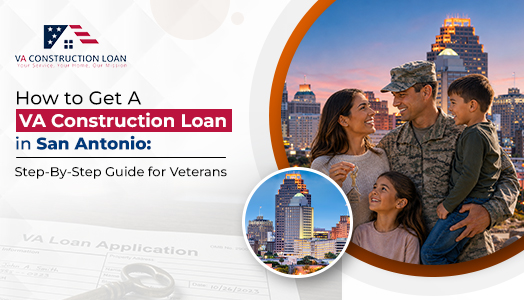
Building a custom home near Joint Base San Antonio can be appealing to veterans. Still, VA construction financing has requirements that differ from those of a standard VA purchase loan. You may need to coordinate eligibility, land selection, builder approval, construction plans, appraisal, underwriting, and construction draws before your project can move forward.
A VA construction loan may allow eligible borrowers to finance a qualifying primary residence with VA-backed financing, subject to entitlement, lender, property, and underwriting requirements. This guide explains how to get a VA construction loan in San Antonio, from obtaining your Certificate of Eligibility and choosing a lot to closing, construction draws, inspections, and completion.
Use the steps below to understand how the process can move from pre-approval and land selection to construction, inspections, and completion.
What is a VA Construction Loan?
Understanding the program is only the first step. You must also meet applicable eligibility, credit, income, debt, property, and construction requirements. The exact underwriting criteria can vary by lender.
A VA construction loan can allow eligible borrowers to finance the construction of a qualifying primary residence using VA-backed financing. Depending on the borrower’s entitlement, loan amount, property, and lender requirements, a down payment may not be required.
In simpler terms, the construction financing and your full mortgage are wrapped into a single loan transaction on a single closing day, also known as a VA one-time close construction loan in San Antonio (also called a VA OTC Loan).
A one-time-close structure combines construction and permanent mortgage financing into a single transaction, which may reduce the need for duplicate closing and settlement costs compared with separate financing arrangements.
The Department of Veterans Affairs guarantees a portion of an eligible VA loan to the lender. VA loans also generally do not require private mortgage insurance. Interest rates and other loan terms vary by lender, borrower qualifications, loan amount, and market conditions.
VA Construction Loan Guidelines & Eligibility San Antonio, TX
Once you understand the applicable financial requirements, you can begin the pre-approval process. You will also need to select a property that meets applicable VA, lender, zoning, land-use, and building requirements.
VA construction borrowers must meet applicable VA eligibility requirements and the lender’s underwriting standards for credit, income, debt-to-income ratio (DTI), and construction financing. Construction loans may have additional lender-specific overlays that are stricter than the VA’s baseline requirements.
These underwriting criteria help the lender determine whether your financial profile supports the proposed loan amount and construction budget.
Under this lender’s current construction guidelines, eligible files must receive an Approve/Eligible recommendation through Desktop Underwriter (DU), and manual underwriting is not permitted. These requirements are lender-specific and should not be treated as universal VA requirements.
The table below summarizes this lender’s current construction-loan underwriting criteria. These figures are lender-specific and may differ from the VA’s baseline requirements.
| Base Loan Amount | Minimum FICO | Max LTV | Max DTI | Underwriting Condition |
|---|---|---|---|---|
| Up to $832,750 | 620 | 100% | 55% | Standard guideline |
| $832,751–$1,000,000 | 620 | 100% | 50% | Lower DTI tier |
| $832,751–$1,000,000 | 640 | 100% | 55% | Higher FICO tier |
| $1,000,001–$2,000,000 | 660 | 95% | 50% | Higher-loan tier |
Note: The two $832,751–$1,000,000 entries reflect different combinations of minimum FICO and maximum DTI under the lender’s current guidelines. These are lender-specific requirements and should not be presented as universal VA loan requirements.
VA construction financing can involve additional documentation and underwriting requirements compared with a standard VA purchase loan. Working with a lender experienced in VA construction financing can help you understand the requirements and keep the process organized.
Under this lender’s current guidelines, borrowers must have at least two valid FICO scores. Because credit-score requirements vary among lenders, confirm the applicable requirements before applying.
Under the lender’s current guidelines, loans exceeding $1,000,000 may require at least three documented compensating factors. These are lender-specific underwriting requirements rather than universal VA requirements.
Eligible Property Types & San Antonio Exclusions
Selecting an eligible property type is an important part of the underwriting process because both VA requirements and lender-specific construction guidelines can restrict which homes qualify.
When choosing a San Antonio construction site, confirm the proposed property type with your lender before purchasing the land or finalizing construction plans. Under this lender’s current construction guidelines, eligible property types may include detached one-unit site-built homes, qualifying barndominiums and modular homes, and certain newly purchased manufactured homes (eligibility can vary by manufacturer and whether the home is single- or multi-width), and two- to four-unit residential properties. Eligibility depends on the lender’s current guidelines and applicable VA requirements.
This lender’s current guidelines exclude attached townhomes, traditional condominiums, cooperative properties, container homes, mixed-use properties, and operating farms or ranches from its VA construction program. Other lenders may have different property eligibility criteria.
If you finance a two- to four-unit property with a VA loan, you generally must occupy one of the units as your primary residence. Under this lender’s current guidelines, projected rental income from the additional units cannot be used to qualify the borrower. Rental-income treatment can vary by lender and underwriting circumstances.
This lender’s construction program is limited to proposed construction projects. If construction has already begun, such as through completed footings, a foundation, or a slab, the project may not qualify under the lender’s current VA construction guidelines. Confirm the property’s status with the lender before beginning work.
How to Get a VA Construction Loan in San Antonio: 9 Steps
Getting a VA construction loan in San Antonio involves several stages, from confirming eligibility to completing construction. The exact requirements vary by lender, but the process generally follows these nine steps:
- Confirm your VA eligibility – Obtain a Certificate of Eligibility (COE) and verify that you have sufficient entitlement for the planned project.
- Get pre-approved – Review your credit, income, debts, residual income, and estimated construction budget with a lender.
- Choose the land – Select a suitable San Antonio-area lot that meets VA, zoning, access, utility, and lender requirements.
- Select an approved builder – Work with a qualified builder who meets the lender’s licensing, insurance, experience, and construction requirements.
- Finalize your plans and budget – Complete the home plans, specifications, fixed-price construction contract, and detailed project budget.
- Complete the appraisal – The VA appraisal reviews the proposed home’s plans, specifications, and estimated market value to determine whether the project meets applicable requirements.
- Complete underwriting and close – The lender verifies your financial qualifications, construction documents, appraisal, builder information, and loan terms before closing.
- Begin construction and receive draws – Construction funds are released in scheduled draws after required inspections verify completed work.
- Complete the home and transition to permanent mortgage payments – After construction is complete, the lender verifies the required completion documentation, and the loan enters its permanent repayment phase in accordance with the loan terms.
In short: A VA construction loan in San Antonio typically moves from eligibility and pre-approval → land and builder selection → plans and appraisal → underwriting and closing → construction draws → completion. Lender-specific requirements can affect the timeline, loan amount, property eligibility, and construction process.
VA Minimum Property Requirements (MPRs) for Construction
VA Minimum Property Requirements (MPRs) help ensure that a property is safe, structurally sound, sanitary, and suitable for residential use. Proposed construction must satisfy applicable VA property requirements as well as local building codes and lender standards. The following requirements are particularly important when planning a new construction project in the San Antonio and Bexar County area.
VA Minimum Property Requirements are addressed in Chapter 12 of the VA Lenders Handbook. Updates to Chapter 12 took effect May 1, 2026. Borrowers should rely on the current VA guidance and their lender’s construction requirements when evaluating a proposed property.
The updated guidance changed the treatment of certain property requirements, including prior radon-related procedures. The lender and appraiser should apply the current VA requirements applicable to the property and construction project. Appraisal timelines vary based on appraiser availability, property complexity, documentation, and local market conditions. Borrowers should confirm the current expected timeline with their lender.
Providing complete plans, specifications, and supporting documentation can help reduce avoidable appraisal and underwriting delays. VA Minimum Property Requirements focus on the property’s safety, structural soundness, sanitation, and suitability for residential use. A VA appraisal is not a substitute for a comprehensive home inspection, which can identify defects and assess the condition and functionality of the home’s systems.
If the property will use a private well, additional water-supply documentation and testing may be required. Confirm the applicable VA, local, and lender requirements before construction begins. Lastly, each VA appraisal will not substitute for a VA home inspection (so we advise hiring a professional home inspector yourself!) in that it will not assess the proper functionality of building systems.
VA Construction Loans: Your Path from Blueprint to Key
For eligible veterans and service members seeking to build a custom primary residence, a VA construction loan in Texas can serve as an alternative to conventional construction financing, subject to VA eligibility and lender requirements.
A VA construction loan may allow eligible borrowers to finance a qualifying custom home with a down payment that can be lower than conventional construction financing, depending on entitlement, loan amount, and lender requirements. Shirley Mueller specializes in VA lending and construction financing and helps borrowers understand eligibility, builder requirements, underwriting, and the one-time-close process.
Her team can assist eligible borrowers through the financing process, from initial qualification and construction planning to closing and project completion. Start your journey with trust and take control of your housing benefits.
About Shirley Mueller
Shirley Mueller is Sr. VP of Veteran Lending, NMLS ID 336103, and has helped 3,000+ military families since 2003. She specializes in entitlement analysis, residual income review, and VA program structuring, and her practice is largely referral-driven.
Schedule a Consultation with Shirley Mueller.
CrossCountry Mortgage, LLC | NMLS ID: 336103 (Shirley Mueller). Equal Housing Lender. This article is for informational purposes only; loan programs, overlays, and eligibility requirements are subject to change and lender approval.
FAQs
1. What is a Certificate of Eligibility (COE) for a VA construction loan?
A Certificate of Eligibility (COE) is a document from the Department of Veterans Affairs that confirms your eligibility for the VA home-loan benefit. It does not by itself guarantee loan approval or a zero-down payment. Your lender can usually obtain the COE on your behalf.
2. Can I apply for a VA construction loan without a COE?
Yes. You can begin the loan application before receiving your COE. Your lender can often request the COE from the VA. Still, they must verify your VA eligibility before final loan approval and closing.
3. Is a VA One-Time Close loan available in San Antonio?
Yes, most lenders that specialize in VA loans offer a one-time-close construction loan in San Antonio. This type of loan combines the cost of your land and your building costs into a single final mortgage payment, with one closing and one round of financing fees.
4. Do I need a down payment for a VA construction loan in San Antonio?
Under this lender’s current construction guidelines, eligible borrowers with full VA entitlement may qualify for 100% financing on loans up to $1,000,000, subject to underwriting requirements. Loans from $1,000,001 to $2,000,000 may require a 5% down payment under the lender’s guidelines.
5. Does my builder need VA approval?
A separate VA-issued Builder ID is no longer required for standard VA construction loans. However, the builder must still meet applicable state and local licensing requirements and the lender’s construction-program requirements, which may include insurance, experience, financial documentation, and lender registration.
6. Why do lenders review builders before approving the loan?
Lenders review builders to assess their qualifications and ability to complete the project. Depending on the lender’s requirements, this review may include business licenses, insurance, financial documentation, construction experience, and other credentials.
7. Is there a VA loan limit in Bexar County?
For a standard VA purchase loan, a Veteran with full entitlement is not subject to a VA-imposed maximum loan amount tied to the county loan limit. Construction financing is different: under this lender’s current construction overlays, the maximum base loan amount is capped at $2,000,000, with the FICO, LTV, and DTI requirements shown in the table above applying at each tier. Your lender will confirm the maximum loan amount you qualify for based on income, debts, credit, residual income, entitlement, appraisal, property requirements, and lender-specific guidelines.
8. Can I qualify with a higher DTI?
Yes. If the loan is less than $832,750 and the applicant has a credit score of at least 620, you can use a debt-to-income ratio up to 55% to qualify. High-DTI files must be approved via an automated system – this means manual underwriting is not permitted.
9. How do property taxes affect a VA construction loan in San Antonio?
Local property taxes can be significant, and when you include these taxes in your monthly escrow payment, the maximum loan amount you are approved for will be smaller. Lenders require that estimated property taxes be considered when determining your debt-to-income and residual income ratios for approval.
10. Does Bexar County’s property tax rate matter during approval?
Yes. Property taxes are included when the lender estimates your housing payment and evaluates your qualifying ratios. Because San Antonio-area property taxes can materially affect monthly housing costs, they can influence the loan amount you qualify for.
11. Do I have to pay a VA funding fee on a construction loan?
The VA funding fee may apply to a construction loan unless you qualify for an exemption. For VA-backed purchase and construction loans, the current funding fee ranges from 1.25% to 3.3%, depending on down payment and whether it is your first or subsequent use of the VA loan benefit. Veterans who meet applicable service-connected disability or other exemption criteria may not have to pay the fee.
12. Can I build outside San Antonio city limits?
Yes, it is possible to build outside of city limits (of San Antonio). That property must meet VA Minimum Property Requirements (MPRs) and be accessible from a paved public street. It needs to have proper water and sewage sources available.
13. Can I build a duplex with a VA construction loan?
Yes, it would be possible to obtain this to construct a multiunit, such as a duplex, if one of those units serves as your primary residence. The loan will not consider future rental income from the second unit toward qualification.